What Did the Government Do to Reduce Violence Against African Americans After the Civil War?
Black codes and Jim Crow laws were laws passed at unlike periods in the southern United States to enforce racial segregation and curtail the power of black voters. Afterwards the Civil War ended in 1865, some states passed black codes that severely limited the rights of black people, many of whom had been enslaved. These codes limited what jobs African Americans could agree, and their ability to get out a job in one case hired. Some states also restricted the kind of property black people could ain. The Reconstruction Act of 1867 weakened the effect of the black codes by requiring all states to uphold equal protection nether the xivthursday Subpoena, particularly by enabling black men to vote. (U.South. police force prevented women of whatever race from voting in federal elections until 1920.) During Reconstruction, many black men participated in politics by voting and by property office. Reconstruction officially ended in 1877, and southern states then enacted more discriminatory laws. Efforts to enforce white supremacy by legislation increased, and African Americans tried to assert their rights through legal challenges. Nevertheless, this endeavour led to a disappointing result in 1896, when the Supreme Court ruled, in Plessy 5. Ferguson, that so-chosen "split up only equal" facilities—including public send and schools—were constitutional. From this fourth dimension until the Civil Rights Act of 1964, discrimination and segregation were legal and enforceable. One of the first reactions against Reconstruction was to deprive African-American men of their voting rights. While the 14th and 15th Amendments prevented state legislatures from directly making it illegal to vote, they devised a number of indirect measures to disenfranchise blackness men. The grandad clause said that a human being could only vote if his ancestor had been a voter before 1867—but the ancestors of most African-Americans citizens had been enslaved and constitutionally ineligible to vote. Another discriminatory tactic was the literacy test, practical by a white canton clerk. These clerks gave blackness voters extremely difficult legal documents to read as a test, while white men received an like shooting fish in a barrel text. Finally, in many places, white local government officials just prevented potential voters from registering. Past 1940, the pct of eligible African-American voters registered in the South was only three percent. As evidence of the reject, during Reconstruction, the percent of African-American voting-historic period men registered to vote was more than than 90 percent. African Americans faced social, commercial, and legal bigotry. Theatres, hotels, and restaurants segregated them in inferior accommodations or refused to acknowledge them at all. Shops served them terminal. In 1937, The Negro Motorist Light-green Book, a travel guide, was first published. It listed establishments where African-American travelers could await to receive unprejudiced service. Segregated public schools meant generations of African-American children often received an education designed to exist inferior to that of whites—with worn-out or outdated books, underpaid teachers, and bottom facilities and materials. In 1954, the Supreme Court declared discrimination in education unconstitutional in Chocolate-brown five. Board of Instruction of Topeka, just information technology would take some other 10 years for Congress to restore full civil rights to minorities, including protections for the correct to vote.
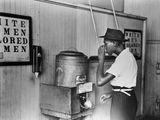
The effort to protect the rights of blacks under Reconstruction was largely crushed by a series of oppressive laws and tactics called Jim Crow and the blackness codes. Here, an African-American man drinks from a h2o fountain marked "colored" at a streetcar terminal in Oklahoma Metropolis, Oklahoma in 1939.
Photograph by Bettmann
14th amendment
Noun
update to the U.South. Constitution guaranteeing all citizens equal protection and due process under the police.
15th amendment
Substantive
update to the U.S. Constitution that allows all citizens the right to vote.
civil rights
Plural Noun
set up of fundamental freedoms guaranteed to all individuals, such every bit participation in the political arrangement, ability to ain property, and due procedure and equal protection under the law.
discrimination
Noun
treatment based on a group to which a person belongs, not the person himself.
enslave
Verb
to totally control.
segregation
Substantive
the systemic separation of people based on race, religion, or caste.
Supreme Courtroom
Substantive
highest judicial authority on bug of national or constitutional importance in the U.S.
voting rights
Noun
bug surrounding the legal correct and ability to entrada and cast a vote in political elections.
hartsellhassing94.blogspot.com
Source: https://www.nationalgeographic.org/encyclopedia/black-codes-and-jim-crow-laws/
0 Response to "What Did the Government Do to Reduce Violence Against African Americans After the Civil War?"
Post a Comment